Posts

Showing posts with the label Collada

Building our 3D web with OurBricks

Image
For years I have been wanting to see 3D on the web become ubiquitous and with Katalabs' OurBricks, I am closer than ever to seeing that dream come true. Leveraging the power of WebGL and its supported browsers, OurBricks allows users to examine a full 3D version of any model uploaded to the site with no need for any plug-in. Visitors to the site can download content, embed it in any webpage as easy as embedding a Youtube video, or drop it into Katalabs' multi-user 3D sandbox for a 'virtual world' type experience. OurBricks seems the ideal solution for 3D artist that want to share their creations. Countless times I have seen on other sites where artists can share their 3D model, in the form of a 2D image, for peer review and "Can you render this model from a different angle," appears somewhere in the comments section. Now that problem is solved! The OurBricks platform supports the following 3D file formats: COLLADA, OBJ, FBX, DXF, and KMZ. There is an option ...


Where2.0 am I ?

Image
This past week at Lat 37.329304, Lon -121.89051, I got the opportunity to attend my first Tim O'Reilly's Where2.0 Conference. 'Now in its sixth year, the Where 2.0 Conference is where the grassroots and leading edge developers building location-aware technology intersect with the businesses and entrepreneurs seeking out location apps, platforms, and hardware to gain a competitive edge. In the O'Reilly conference tradition, Where 2.0 presents leading trends rather than chasing them. At Where 2.0, you 'll find source mapping tools, reality mining, open standards for data and location web services, and sensors for obtaining location data. We'll learn how the established geo industry is reacting to the first businesses making money from their grassroots geospatial projects. There's no better place to meet the people behind the mashups , the people behind the platforms, and the people looking ahead to the future of geospatial . Join us at Where 2.0 to debate...

Metaverse U '09 - All about the open virtual space

Image
This past weekend was the second iteration of Metaverse U put on by Henrik Bennetsen at Stanford University. The Metaverse U conference took place at Stanford University on May 29 th and 30 th . The goal of this years conference was to explore the cutting edge applications of virtual worlds and the open platforms that drive them. Henrik gathered an impressive lineup of speakers and I will embed their videos here once they go online. Some highlights from the presentations: Sirikata , Stanford's open source platform for virtual worlds, had a high representation this year with a demo that showed some of its editing features. Jeffrey T. Schnapp (Stanford University) talked about cultural heritage with virtual worlds stating "museums are the original 3D world" and the need to embrace (inter)active models of educational programming with an emphasis on bottom-up counterparts to traditional top-down approaches. John Hurliman (Intel) presented Cable Beach, a service based a...

Web3D Tool #2 - Vivaty (formerly Flux) Studio

Image
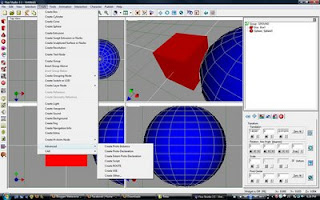
Vivaty recently announced the release of Vivaty Studio . Formerly Flux Studio 2 (MediaMachines), it is a web3D authoring tool for creating geometry, animation, and interactivity. It imports from a variety of formats, exports the open standard (X3D,X3dv,VRML) formats and Vivaty's own encrypted fx3d format. Here for a full feature list . Although Vivaty Studio is a 3D modeling and animation application, the real value add of this application is the web3D authoring. I highly recommend Vivaty Studio for 3D artists and programmers. For artists and those slightly familiar with standard 3D modeling software, it has a user-friendly UI to get one creating interactive content in no time. Simple wizards and drag/drop menu features can add basic functionality to 3D objects in a few clicks. Animations can be made in Vivaty Studio with a simple animation time-line or imported directly from other DCC tools (personally found COLLADA imports work best). Most of the 3D artists I work with love wo...

Web3D Tools #1: X3D-Edit

Image
Here is a great tool for all you programmers that work with or are interested in getting started with the web3d open standard X3D. X3D-Edit is an Extensible 3D (X3D) graphics authoring tool for simple error-free editing, authoring, and validation of X3D scenes. X3D-Edit is written in XML and Java using the Netbeans platform and so is portable across major desktop and laptop operating systems (Windows MacOSX Linux Solaris). X3D-Edit requires Java (version 5 or 6) and features include: - Collada .dae model validation, code completion, and conversion to .x3d (XML) encoding -direct editing of X3D scenes using the XML (.x3d) encoding, -embedded visualization of scenes using the Xj3D viewer, -XML validation against X3D DTDs and Schemas, -drag-and-drop palette for X3D nodes, -popup panels for node editing, -extensive help resources. A huge download, but way better than authoring in the standard text editor. ...

Shall we exit reality?

Image
ExitReality , a London headquartered start-up with offices in Australia and Los Angeles, is another open standards supporter making its entrance into the immersive web targeting social networks. ExitReality is a social media company with an enhanced 3D, multi-user, immersive messaging environment. After signing up for the beta, and installing the player, one enters with an avatar in a 3D plaza at sunset. Carls Jr and Hardees have 3D spaces here, the Match.com ice cream truck (??) is off to the side. Now before I can agree that this is " just another VRML world ", I cant help but think of the player. The ExitReality player displays X3D / VRML and COLLADA content. It supports interactive Flash as a polygon texture. The interface has a stylish look that seems like a mash-up of Vista and Itunes . It allows you to drag/drop assets into any world for personalization with standard editing tools (move, rotate, scale, clone, delete, save). It has a buddy list, chat, and ot...